Healing Doesn't Only Happen in a Therapy Room

On the spectrum of healing, the things that count, and why there's no rule book.
There's a particular kind of conversation that happens in Indian households when someone is struggling.
Either it gets dismissed — "sab theek ho jayega, don't think too much" — or it escalates to "you need to see someone."
Therapy or nothing. Fix it or bury it.
And somewhere in that binary, an entire spectrum of healing gets lost.
Because here's what nine years of working with people has taught me — healing is not a destination you arrive at after completing the right programme or attending the right number of sessions. It is not reserved for people with diagnosed conditions or significant trauma histories. And it does not follow a linear path from broken to fixed.
Healing is anything that helps your nervous system feel safer than it did before.
That definition might feel too simple. But sit with it for a moment.
The Nervous System Is the Starting Point
When we experience something difficult — a toxic relationship, a hostile work environment, a childhood that didn't feel safe, a loss, a period of chronic stress — our nervous system responds by shifting into a state of protection. It becomes hypervigilant. It scans for threat. It organises our behaviour around keeping us safe, even when the original danger is long gone.
This is not a character flaw. This is biology doing exactly what it was designed to do.
But healing — in any form — is the process of signalling to that nervous system that it is safe to come out of protection mode. That the threat has passed. That it can regulate again.
And that signal can come from many places. Not just a therapist's room.
The Spectrum Nobody Talks About
Stepping out of a toxic environment and feeling safe again — that's healing.
The body physically relaxes when chronic stress is removed. Cortisol levels drop. Sleep improves. The jaw unclenches. Research consistently shows that environmental change is one of the most powerful interventions available — because you cannot heal in the same environment that made you unwell.
Taking efforts to change old patterns — that's healing.
Every time you pause before reacting the way you always have, every time you choose the unfamiliar response over the conditioned one, you are literally rewiring neural pathways. Neuroscience calls this neuroplasticity — the brain's capacity to form new connections based on new behaviour. It is slow, unglamorous work. But it is profoundly biological.
Taking a small break for yourself every day — that's healing.
Not a luxury. Not selfishness. The default mode network — the part of the brain that processes emotion, consolidates memory, and makes meaning — activates during rest. It needs downtime to do its job. A daily moment of genuine rest is not indulgence. It is maintenance.
Taking care of your nutrition and fitness — that's healing.
The gut-brain connection is one of the most well-researched areas of modern neuroscience. Approximately 90% of serotonin — the neurotransmitter most associated with mood regulation — is produced in the gut. What you eat affects how you feel at a neurochemical level. Movement releases endorphins, reduces cortisol, and has been shown in multiple studies to be as effective as medication for mild to moderate depression. The body and mind are not separate systems.
Replacing toxic relationships with healthier ones — that's healing.
We are profoundly social creatures. The quality of our relationships directly affects our nervous system regulation. Co-regulation — the process by which one calm nervous system helps another settle — is something we experience from infancy and continue to need throughout our lives. Safe, consistent relationships are not just emotionally comforting. They are neurologically regulating.
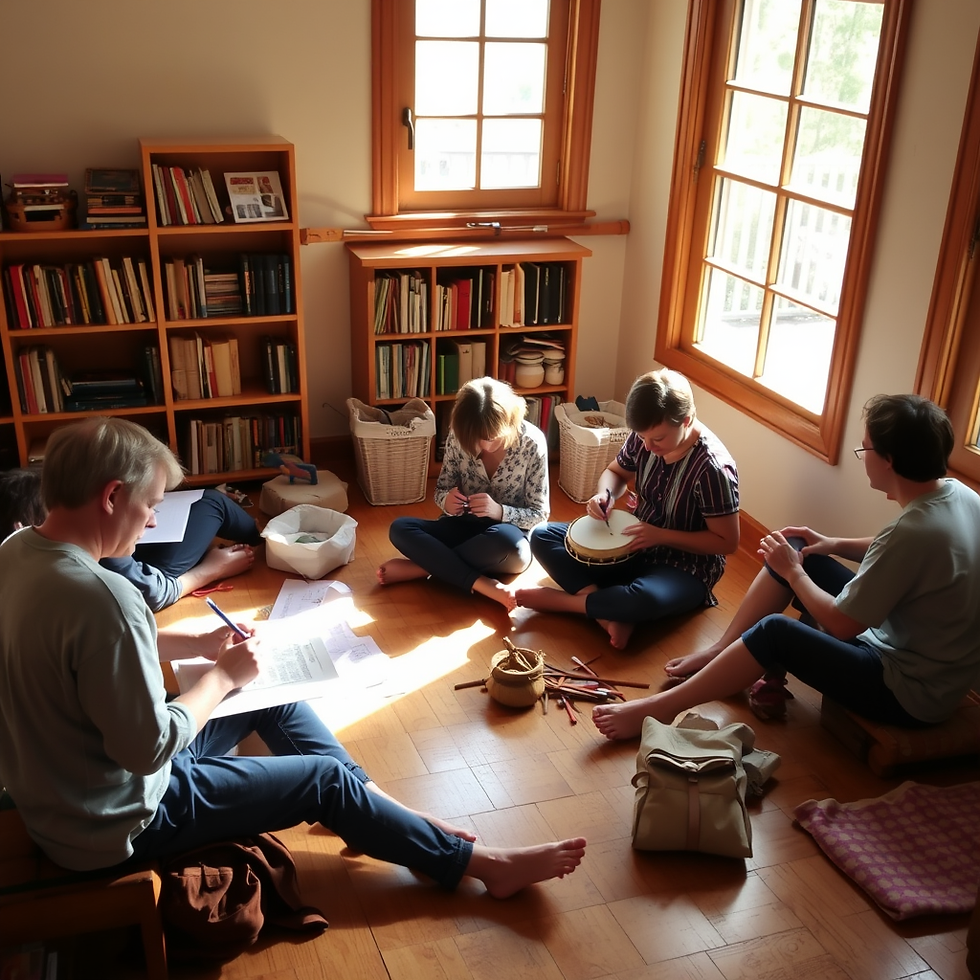
Creative expression — that's healing.
Making something — drawing, writing, moving, humming, shaping clay — accesses parts of emotional experience that language cannot always reach. Arts-based therapy exists precisely because the body and the creative process can process what the thinking mind cannot articulate. But you don't need a therapy setting for this. You just need the permission to make something without it having to be good.
So Where Does Therapy Fit?
Therapy is not the only form of healing. But it is a particular kind — one that offers a trained, consistent, boundaried relationship within which to explore the things that are harder to reach alone. It is especially useful when patterns feel stuck, when the nervous system seems unable to regulate despite other efforts, when there are roots that need careful, supported exploration.
It is one point on the spectrum. An important one. But not the only one.
There Is No Rule Book
Healing can be one of these things. It can be all of them at once. It can be different things in different seasons of your life.
What matters is not whether you are doing it the right way. What matters is whether what you are doing is helping your nervous system feel incrementally safer, more regulated, more at home in itself.
That is the whole measure.
So if you have been waiting until things are bad enough for therapy — you don't have to wait.
And if therapy feels inaccessible right now — financially, emotionally, logistically — you are not without options.
The spectrum is wide. And you are probably already somewhere on it, doing something that counts, without knowing to call it healing.
It counts. All of it counts.


Comments